What Sapporo Taught Me About Japan’s Soul
You know that feeling when a city surprises you? Sapporo wasn’t just snow and ramen—I stumbled into something deeper. Between lantern-lit alleys and quiet shrines wrapped in frost, I found a side of Japan few tourists see. It’s modern, yes, but rooted in Ainu traditions and seasonal rituals that shape daily life. This isn’t just travel—it’s cultural immersion. Let me take you beyond the guidebooks to the heartbeat of Hokkaido.
First Impressions: Beyond the Snow Festival Hype
Arriving in Sapporo for the first time, many travelers expect a postcard of winter—ice sculptures, bustling crowds, and the glow of the Sapporo Snow Festival. And yes, the Yuki Matsuri is a dazzling spectacle, drawing hundreds of thousands each February with its towering snow statues and illuminated tunnels. But the city’s true character reveals itself only when the festival crowds disperse, the scaffolding comes down, and the streets return to their everyday rhythm. What surprised me most was not the spectacle, but the stillness—the way the city breathes between events, how life continues beneath the snowdrifts and frost-laced rooftops.
Most visitors come for the festival and leave shortly after, missing the quiet pulse of Sapporo’s daily life. They rush from one attraction to the next, checking off boxes like the Clock Tower and Susukino’s neon-lit alleys, without pausing to notice the elderly couple sharing a bench in Odori Park, wrapped in thick coats, or the local fishmonger at Nijo Market expertly filleting salmon before dawn. The depth of the city lies not in its highlights, but in its ordinary moments—the steam rising from manhole covers, the precise timing of subway doors, the way shopkeepers bow slightly even when no one is watching.
Stepping off the main tourist trail, I discovered a different Sapporo—one that moves at a gentler pace. One morning, I wandered into a neighborhood sentō, a public bath tucked between a laundromat and a small grocery. Inside, the air was thick with warmth and the scent of cedar. Elderly residents soaked in silence, their conversations soft and infrequent. There was no performance, no expectation to perform. It was simply life as it’s lived. That moment, more than any festival or monument, taught me that Sapporo’s soul is not in its grandeur, but in its authenticity.
The Flavor of Tradition: Eating Like a Local
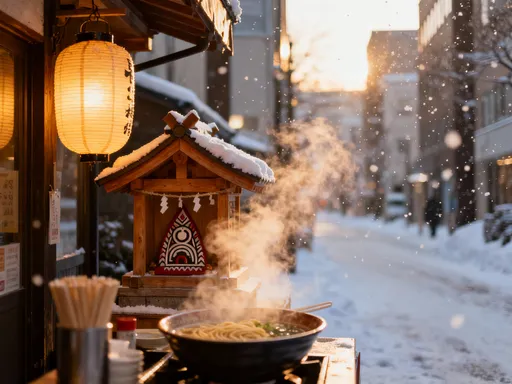
If Sapporo has a heartbeat, it beats strongest in its kitchens. The city’s food culture is not just about sustenance—it’s a living archive of history, migration, and resilience. Take miso ramen, the dish most associated with Sapporo. It’s rich, bold, and deeply warming, a bowl of thick noodles swimming in a savory, reddish-brown broth. But this isn’t just comfort food; it’s a product of necessity. After World War II, when food was scarce and winters were harsh, local chefs began using miso paste—a fermented soybean staple—to create a heartier, more filling broth. What began as survival became identity.
Today, ramen is everywhere, but the best bowls are found not in flashy tourist spots, but in narrow alleyways and basement counters where regulars know the owner by name. At one such spot near the old railway station, I watched a salaryman slurp his noodles with focused intensity, his briefcase resting beside him. The chef nodded without a word, refilling his broth with practiced ease. There’s a ritual here—an unspoken understanding that food is not just eaten, but experienced. Slurping is encouraged, not out of rudeness, but to cool the hot noodles and enhance the aroma. Finishing every drop is a sign of respect.
Equally revealing is the city’s relationship with the sea. At Nijo Market, just steps from downtown, the morning air hums with activity. Fishermen unload crates of ikura, uni, and snow crab, their hands moving with the precision of surgeons. Locals weave through the stalls, selecting fresh cuts for home meals or stopping at tiny counters for a quick breakfast of grilled scallops and sake. This is not a market designed for Instagram—it’s a working space, a hub of daily life. I once stood beside a grandmother teaching her granddaughter how to pick the ripest sea urchin, their voices soft but certain. In that moment, I realized food in Sapporo is not just about taste—it’s about continuity, about passing down knowledge one bite at a time.
To eat like a local is to embrace rhythm and restraint. Izakayas, the casual drinking pubs scattered throughout the city, are where this balance shines. Unlike the loud, rowdy bars in Tokyo, Sapporo’s izakayas are often small, intimate spaces where conversation flows quietly over plates of yakitori and pickled vegetables. Order a beer and a few small dishes, and you’ll likely be joined by neighbors who nod in greeting but don’t intrude. It’s a culture of shared space without forced interaction—a delicate dance of presence and privacy.
Ainu Heritage: Japan’s Indigenous Heart
Beneath the modern skyline of Sapporo lies a deeper history—one that predates the city itself. The Ainu people, the indigenous inhabitants of Hokkaido, have lived in this region for centuries, long before Japanese settlers arrived in the Meiji era. Their culture, shaped by a profound connection to nature, animist beliefs, and oral traditions, remains a vital thread in Sapporo’s identity, though it has often been overlooked in mainstream narratives of Japan. To understand Sapporo fully is to recognize the Ainu not as a footnote, but as the foundation.
One of the most meaningful experiences of my visit was spending a morning at the Hokkaido Museum, where a dedicated wing honors Ainu heritage. Glass cases display intricately carved wooden bears, traditional robes embroidered with geometric patterns, and tools used for fishing and hunting. But more powerful than the artifacts are the stories—recorded voices of elders speaking in Ainu, a language that was once suppressed but is now being revived. I listened to a grandmother recount a legend about the wind spirit, her voice trembling with emotion. It was not a performance; it was preservation.
Outside the museum, I visited Pirka Kotan, a cultural village designed to share Ainu traditions with visitors. Here, artisans demonstrated wood carving, weaving, and the making of *ikupasuy*, sacred wooden sticks used in rituals. A guide explained that every element of Ainu life is infused with reverence for the natural world—animals are not seen as resources, but as *kamuy*, or spiritual beings. Even the act of hunting is accompanied by prayers of gratitude. This worldview, so different from modern consumerism, offers a quiet challenge to the way many of us live today.
Understanding Ainu culture transforms how one sees Japan. It reminds us that the nation is not a monolith, but a tapestry of histories and identities. In Sapporo, this coexistence is visible in small ways—a bilingual sign at a park, a festival that includes Ainu dance, a restaurant that serves *ohaw*, a traditional soup. These are not tourist attractions; they are acts of recognition. And for the traveler willing to look closely, they offer a more honest, more human portrait of the country—one that honors both progress and memory.
Seasons That Shape the City
Sapporo does not merely experience the seasons—it is shaped by them. With winter temperatures often dropping below -10°C and snowfall averaging over five meters a year, the city’s rhythm is dictated by climate. Architecture, transportation, and daily routines are all designed with the extremes in mind. Heated walkways snake through downtown, keeping sidewalks clear. Subway stations are connected by underground malls, allowing residents to move across the city without stepping into the cold. Even homes are built with double-glazed windows and efficient heating systems, a quiet testament to resilience.
Yet Sapporo does not resist winter—it embraces it. The Snow Festival is the most visible celebration, but the city’s relationship with the season runs deeper. In the mornings, you’ll see children building snowmen on their way to school, their scarves fluttering like flags. Elderly couples walk slowly through snow-covered parks, their footsteps muffled by the quiet. There’s a sense of calm, of beauty found in stillness. Even the food changes—hot pots, miso soup, and grilled fish dominate menus, offering warmth from the inside out.
But Sapporo is not only a winter city. When spring arrives, it does so with quiet determination. Cherry blossoms bloom in Maruyama Park, their pale pink petals drifting onto the last patches of melting snow. Locals gather for *hanami*, not in large, boisterous groups, but in small family clusters, sharing bento boxes and soft conversation. Summer brings greenery and light that lingers past 8 p.m., with festivals like Yosakoi Soran filling the streets with drumming and dance. And autumn—brief but brilliant—paints the hills in gold and crimson, a final burst of color before the snow returns.
The concept of *shun*, or seasonality, is central to Japanese life, and in Sapporo, it is lived, not just observed. Farmers’ markets overflow with fresh corn in August, wild mushrooms in September, and sweet potatoes in November. Restaurants change their menus with the calendar, honoring what is fresh and local. This deep attunement to nature’s cycles is not nostalgia—it’s sustainability, passed down through generations. For the visitor, it offers a chance to slow down, to notice, to appreciate the fleeting beauty of each moment.
Urban Design With a Human Touch
Sapporo’s layout is unusually orderly for a Japanese city—a grid system laid out in the 19th century by Meiji-era planners who envisioned a modern, functional capital for Hokkaido. Unlike the winding alleys of Kyoto or the dense maze of Tokyo, Sapporo’s streets are wide, straight, and easy to navigate. At first glance, it might seem too planned, too rational. But this design reveals its wisdom over time. The wide avenues allow snowplows to clear streets efficiently in winter. The large blocks create space for parks, gardens, and community centers. And the grid makes it simple for visitors to find their way, reducing the stress that often accompanies travel in unfamiliar cities.
At the heart of it all is Odori Park, a 1.5-kilometer green ribbon that cuts through the city center. In winter, it becomes the site of the Snow Festival, lit up with ice sculptures and food stalls. In summer, it hosts concerts, flower exhibitions, and the Sapporo Summer Festival. But even in between events, it serves as a vital lung for the city—a place where people walk dogs, jog, or sit on benches with a book. I often returned in the early morning, when the park was empty except for a few elderly men practicing tai chi, their movements slow and deliberate. There’s a sense of ownership here, of belonging.
What stands out is how public spaces are designed not just for function, but for connection. Statues of historical figures stand alongside modern art installations. Benches are spaced to allow both solitude and conversation. In winter, heated shelters provide warmth without enclosing the view. And throughout the year, local events—farmer’s markets, craft fairs, music performances—bring residents together in ways that feel organic, not forced. This is urban planning with empathy, a city that remembers it exists for people, not just infrastructure.
Even the transportation system reflects this human-centered approach. The subway is clean, punctual, and well-marked in both Japanese and English. Buses are equipped with low floors and ramps for accessibility. And the streetcars, though limited in number, add a nostalgic charm, their bells ringing softly as they glide through residential neighborhoods. Riding them, I felt not like a tourist, but a temporary citizen, moving through the city as locals do.
Living Like a Local: Temples, Trams, and Tiny Bars
To know Sapporo is to live in its rhythms, if only for a few days. I began one morning riding the Tozai Line subway with a crowd of salarymen, their briefcases clutched tightly, their eyes fixed on smartphones or closed in quiet rest. No one spoke. No one needed to. There was a dignity in their routine, a quiet commitment to the day ahead. I followed them to Hokkaido Shrine, nestled at the edge of Maruyama Park. Unlike the grand shrines of Kyoto, this one feels intimate, almost hidden. Visitors clap twice, bow, and whisper prayers beneath towering trees. I stood at the edge, watching a woman place a small offering of rice, her hands folded in quiet gratitude. There was no performance, only presence.
Later, I wandered into a neighborhood of low-rise homes and narrow streets, where laundry hung between buildings and cats napped on sunlit walls. I found a tiny bar, no larger than a closet, where five stools faced a single counter. The owner, a man in his sixties with a weathered face and kind eyes, poured me a glass of local whisky without asking. We didn’t speak much, but he nodded when I complimented the drink. This is *tachinomi* culture—standing bars where drinks are cheap, conversation is optional, and time slows down. It’s not about getting drunk; it’s about unwinding, about being seen without being scrutinized.
Throughout the day, I noticed the unspoken rules that govern Japanese urban life. People queue without being told. They speak softly on public transit. They remove their shoes before entering homes and certain restaurants. These are not laws, but shared understandings—small acts of respect that create harmony. I once saw a young woman pick up a piece of litter without hesitation, placing it in her bag until she found a bin. No one noticed. No one applauded. But the city was cleaner because of her.
And then there are the small temples—so quiet, so overlooked. One afternoon, I turned down a side street and found a tiny shrine, its red gate faded by time. A single bell hung at the entrance. I rang it, clapped twice, and stood in silence. No one else came. But I felt something shift—a sense of peace, of connection to something larger. In that moment, I understood that spirituality in Japan is not always grand or loud. Often, it’s found in the smallest places, the quietest moments.
Why Sapporo Changes How You See Japan
Sapporo does not shout. It does not dazzle with neon or overwhelm with crowds. Instead, it reveals itself slowly, like a photograph developing in a darkroom. It taught me that Japan is not just temples and technology, not just Tokyo’s speed or Kyoto’s elegance. It is also the quiet dignity of a snow-covered park, the warmth of a ramen broth on a winter night, the resilience of a culture that honors both past and present.
What makes Sapporo different is its balance. It is modern, yet rooted. Urban, yet deeply connected to nature. International, yet fiercely local. It does not erase its history to make way for progress; it integrates it. The Ainu presence, the seasonal rituals, the thoughtful urban design—all of it speaks to a city that values depth over spectacle, substance over speed.
For the traveler, Sapporo offers a rare gift: the chance to see Japan not as a destination, but as a way of life. It invites slowness, observation, and humility. It reminds us that culture is not something you consume, but something you participate in—even if only for a few days. You don’t need to understand every custom to respect them. You don’t need to speak the language to feel the warmth.
In the end, Sapporo changed how I travel. I no longer seek only the famous landmarks or the perfect photo. I look for the quiet moments—the steam from a market stall, the bow of a shopkeeper, the hush of a snowfall at dusk. These are the fragments that form a deeper truth. And in them, I found not just a city, but a soul—one that echoes long after the journey ends.